

The escalation in the tariff conflict between Canada and the U.S. has not only solidified Ottawa’s intention to enhance military collaboration with Europe and Asia but is also negatively impacting the likelihood of significant military acquisitions from the United States.
In a recent interview, the leader of the Defence Investment Agency indicated that Canadians would likely oppose sole-source military contracts awarded to American companies.
“That’s just me gauging public sentiment,” stated Stephen Fuhr, the secretary of state for defence procurement. “I believe that pursuing such contracts would be quite challenging, especially following recent events. I think the public would not support that.”
-
Canada announces Defence Investment Agency to manage purchase, delivery of military equipment
-
Ottawa to expand defence buying powers when national, economic security at stake
The retaliatory tariffs announced by Canada this week did not specifically target the defense sector. Nevertheless, Fuhr’s remarks indicate a growing hesitation regarding potential purchases of U.S. military equipment.
He emphasized that Canada cannot assume that relations will simply revert to their previous state once U.S. President Donald Trump exits the presidency in January 2029.
While Canada has committed to spending tens of billions more on defense in the upcoming years, it aims to end the trend of 70 percent of those expenditures going to American sources.
“We find ourselves in a situation that we did not create, and one we do not deserve,” Fuhr said. “We are affected by this change, and it is our responsibility to seek new opportunities and adapt swiftly to address this moment, ensuring we do not find ourselves in this position again.”
Canada ‘carefully considering’ its options
Fuhr continues to regard the United States as a vital ally in defense matters but insists that Canada has recognized the dangers of “putting all our eggs in one basket.” He is particularly keen on increasing Canada’s self-sufficiency in military production or establishing new strategic partnerships.
“We are actively considering collaborations with others who wish to partner with us and enhance our efforts. This does not diminish our relationship with our traditional ally, but the circumstances have changed, and it is evident that our previous relationship will evolve moving forward,” Fuhr remarked.
Justin Massie, an expert in military affairs at Université du Québec à Montréal, stated that Canada must adapt its defense strategy to reflect the new reality with the United States.
“The U.S. desires that its allies bear the responsibility for their own defense,” Massie noted. “They are weary of relying on American taxpayers to support the defense of Europe and Canada.”
Richard Shimooka, a senior fellow at the Macdonald-Laurier Institute, believes Canada will still need to collaborate with the U.S. on continental defense, even as its defense budget approaches over two percent of GDP.
“Canadians need to understand that this cannot be done in isolation. Even with a ten percent defense budget, it would still fall short,” he commented.
Fuhr did not specify any particular military initiatives that might face delays or interruptions due to the ongoing trade dispute.
However, significant military helicopter acquisitions currently in progress could be affected, including a possible sole-source deal for American-made Black Hawks, which are regarded as the top choice for Canada’s special forces.
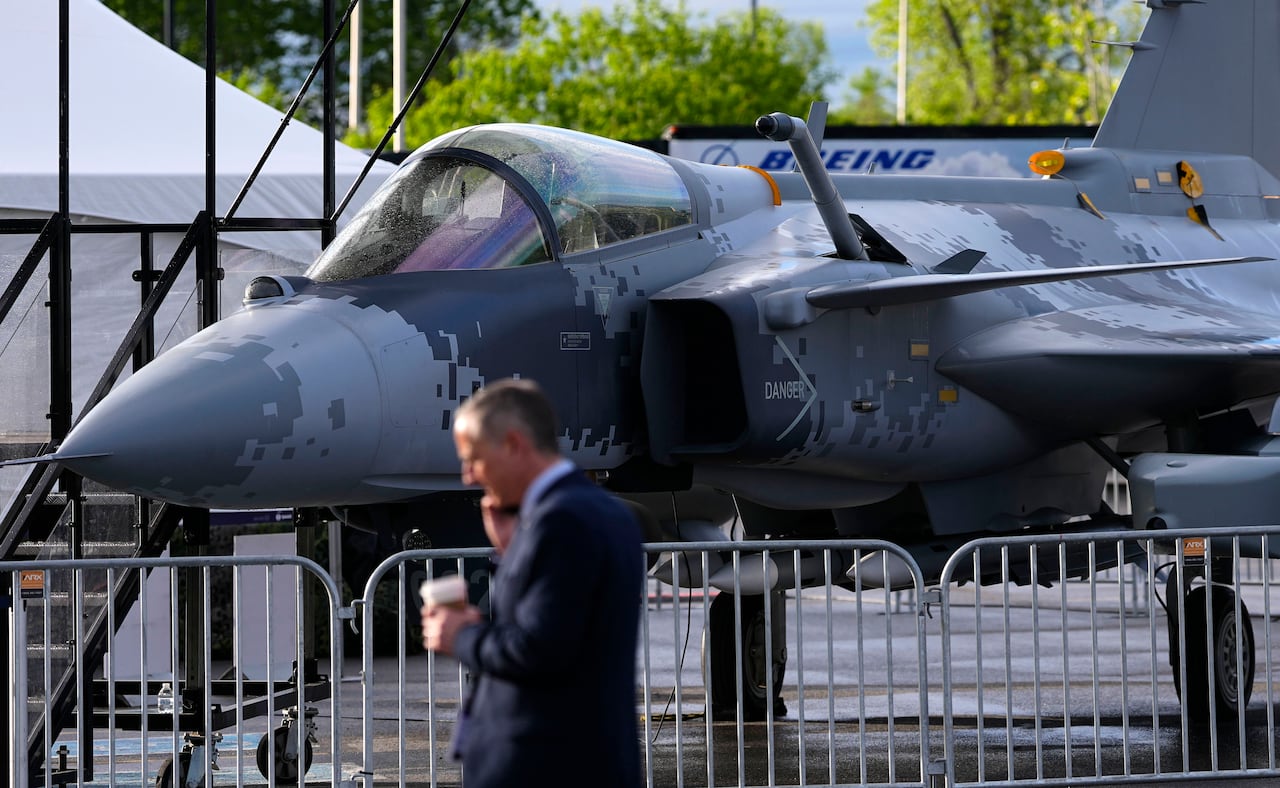
A replica of a Gripen multirole fighter aircraft is displayed at the CANSEC defense industry trade show in Ottawa on May 28, 2026. Canada is still interested in acquiring a second fleet of jets produced by Swedish firm Saab. (Justin Tang/The Canadian Press)
Additionally, the findings of a review concerning the planned acquisition of 88 F-35 fighter jets from U.S. defense company Lockheed Martin remain undisclosed, and Prime Minister Mark Carney has not provided any updates on his plans.
Canada has made a firm order for 16 F-35s and has commenced payments for essential equipment for 14 more aircraft, yet there is currently no clarity on how many additional fighters will be procured beyond this initial order.
-
Ottawa’s mixed fleet of F-35s and Gripens could total more than 100 aircraft, sources say
-
Saab’s surveillance jet deal with Canada faces a U.S. stealth tech hurdle
In the meantime, Canada is still keen on acquiring a second fleet of Gripen fighter jets from Swedish manufacturer Saab.
Ottawa is also in talks with Saab to obtain GlobalEye radar aircraft, developed in collaboration with Canadian firm Bombardier, despite ongoing lobbying for Boeing’s E-7 Wedgetail.
‘Thrilled’ with $2.3B Telesat contract
Fuhr expressed his excitement over the recent $2.3 billion contract awarded to Telesat for Arctic military satellite communications. This initiative aims to lessen Canada’s dependence on Elon Musk’s Starlink network, operated by the American company SpaceX.
Fuhr mentioned that the federal government intends to maintain partnerships with Canadian branches of foreign contractors.
“We view those entities as part of our team,” he stated. “They provide employment to hundreds of Canadians, contribute taxes in Canada, have their headquarters here, conduct engineering work in Canada, and retain intellectual property rights in Canada — all of which are significant.”
However, he highlighted an increasing dialogue regarding the necessity to reduce the stringent U.S. regulations governing key military technology, which are governed by the International Traffic in Arms Regulations (ITAR).
“Is there a scenario where we can operate with fewer ITAR restrictions? I believe there is,” Fuhr stated, referencing enhanced collaboration with partners across Europe, Asia, and Oceania.
“No one can manage everything independently like the U.S. can. Let’s be realistic about this. But together, we certainly can, and I think efforts are being made to move in that direction.”