

An Ontario Superior Court judge has granted bail to a woman facing human trafficking charges, permitting her release without a cash deposit, even as new provincial regulations mandate full payment within 48 hours.
Justice Scott Cowan allowed the woman to be released in Milton on Wednesday after she and her sureties committed to an $11,000 pledge and agreed to a payment promise.
Recent modifications to the bail system implemented by the province this week require individuals accused of crimes to provide a cash security deposit upon their release. Previously, they or their sureties were only obligated to forfeit the funds if the accused violated their release terms and the court mandated payment.
The changes, announced by Ontario’s Attorney General Doug Downey on August 14, came into effect on Monday.
Two legal organizations, the Canadian Civil Liberties Association (CCLA) and the Criminal Lawyers’ Association (CLA), have initiated a constitutional challenge against the new regulations, arguing that “mandatory cash bail” is unfair.
Jessyca Greenwood, vice president of the CLA, noted that if there is a conflict between the federal Criminal Code and provincial laws, the federal law prevails. She emphasized that the Criminal Code allows judges discretion in granting bail with specific conditions.
The legal challenge from the CCLA and CLA is scheduled to be heard in court next week.
“We argue that it is unconstitutional to require individuals to pay because those without financial means will be denied release, which is unjust,” Greenwood stated.
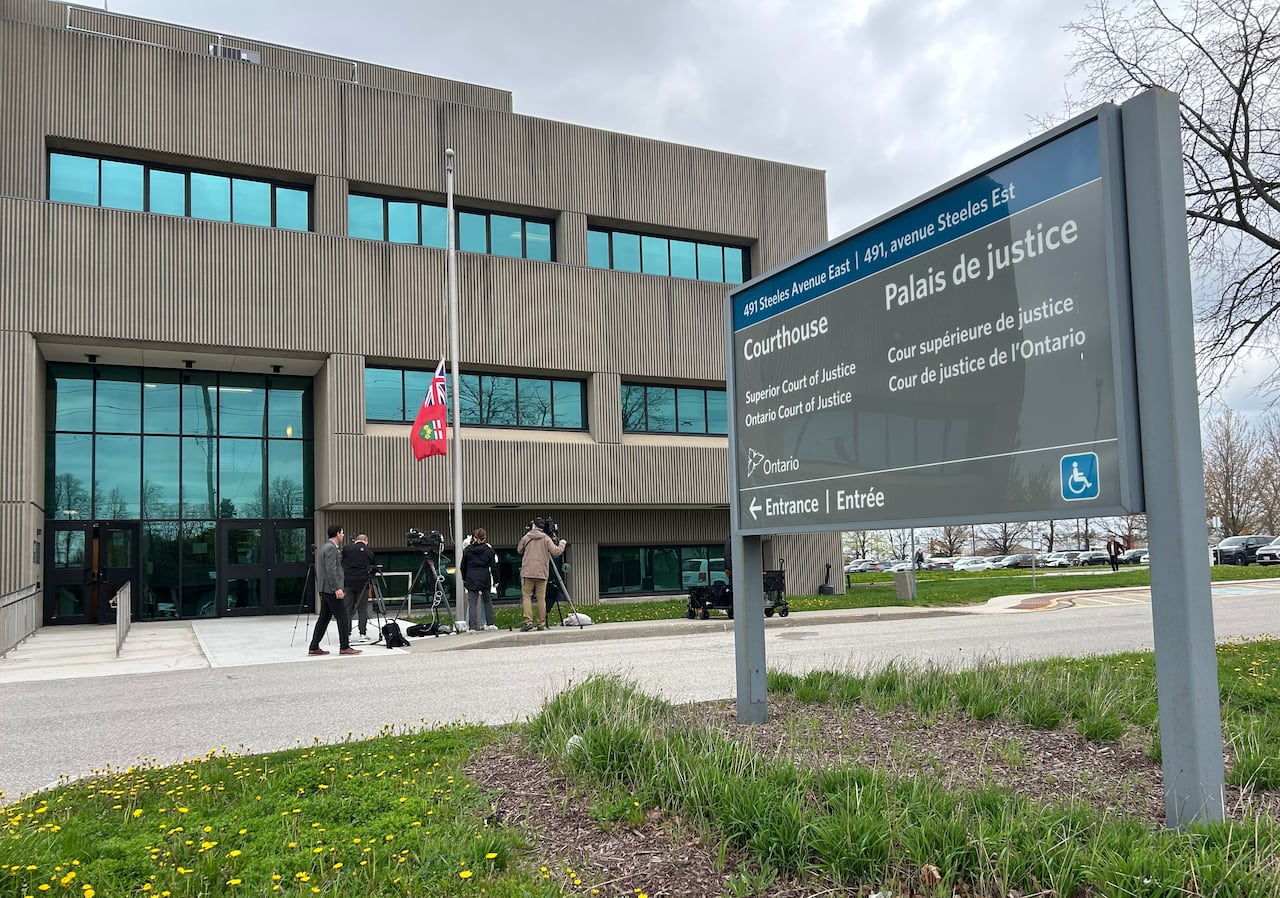
The Milton, Ont. courthouse is shown on Tuesday, May 5, 2026. The challenge by the CCLA and CLA will be heard in court next week. (Alhmidi Maan/The Canadian Press)
Defence attorney Leora Shemesh, representing the woman, expressed in an email on Friday that her client was released under stringent conditions and that the judge’s decision was appropriate.
“My client is presumed innocent of all charges before the court. She, like all Canadians, has the right to bail when deemed appropriate by the court. In this instance, my client has no prior criminal history, and we presented a highly restrictive release plan in line with fundamental justice principles,” Shemesh remarked.
“My client was released with strict bail conditions and a pledge to pay,” she added. “If she breaches her bail, the government may opt to seize those funds. This mechanism has always been a part of our bail system.”
Province states changes aim to ‘make bail more real’
In a statement on Friday, Hannah Jensen, a spokesperson for Ontario Premier Doug Ford’s office, addressed the judge’s ruling, asserting that the new regulations are intended to safeguard the public.
“It is unacceptable to release violent offenders onto our streets shortly after they commit a crime,” Jensen stated. “The justice system has a duty to keep human traffickers incarcerated.”
“Our modifications are aimed at making bail more substantial and impactful, ensuring that the justice system possesses the necessary tools to protect victims and communities,” she explained.
Groups assert ‘province cannot rewrite federal law’
The CCLA and CLA indicated in a news release that the newly implemented cash bail system infringes upon the Constitution. They asserted that criminal procedure is a federal jurisdiction under the Constitution, and the Criminal Code, being a federal statute, grants judges the authority to decide whether to impose a security deposit or cash bail.
-
Legal groups question constitutionality of Ontario’s new cash bail system
-
Ontario launching cash bail system Monday, critics plan legal challenge
“The province cannot alter federal law. Nor can it infringe upon the s.11(e) Charter right to not be denied reasonable bail,” the release stated.
“The province already possesses mechanisms to address significant violations of bail conditions by seeking forfeiture of pledged amounts when bail conditions are breached,” it continued. “Implementing evidently unconstitutional laws is an erratic approach to managing the criminal justice system.”