

A partial lunar eclipse will be observable throughout the country on the night of August 27-28.
This event occurs approximately two weeks following the total solar eclipse that was visible in Iceland, Spain, and a small area of Portugal.
Though it will be a partial eclipse, it promises to be quite significant, with a maximum of 93 percent coverage.
Lunar eclipses happen when the moon traverses Earth’s shadow, known as the umbra. Before reaching the umbra, it first goes through the outer, fainter shadow called the penumbra. This outer shadow is much less visible, making it hard to detect with the naked eye during the transition.
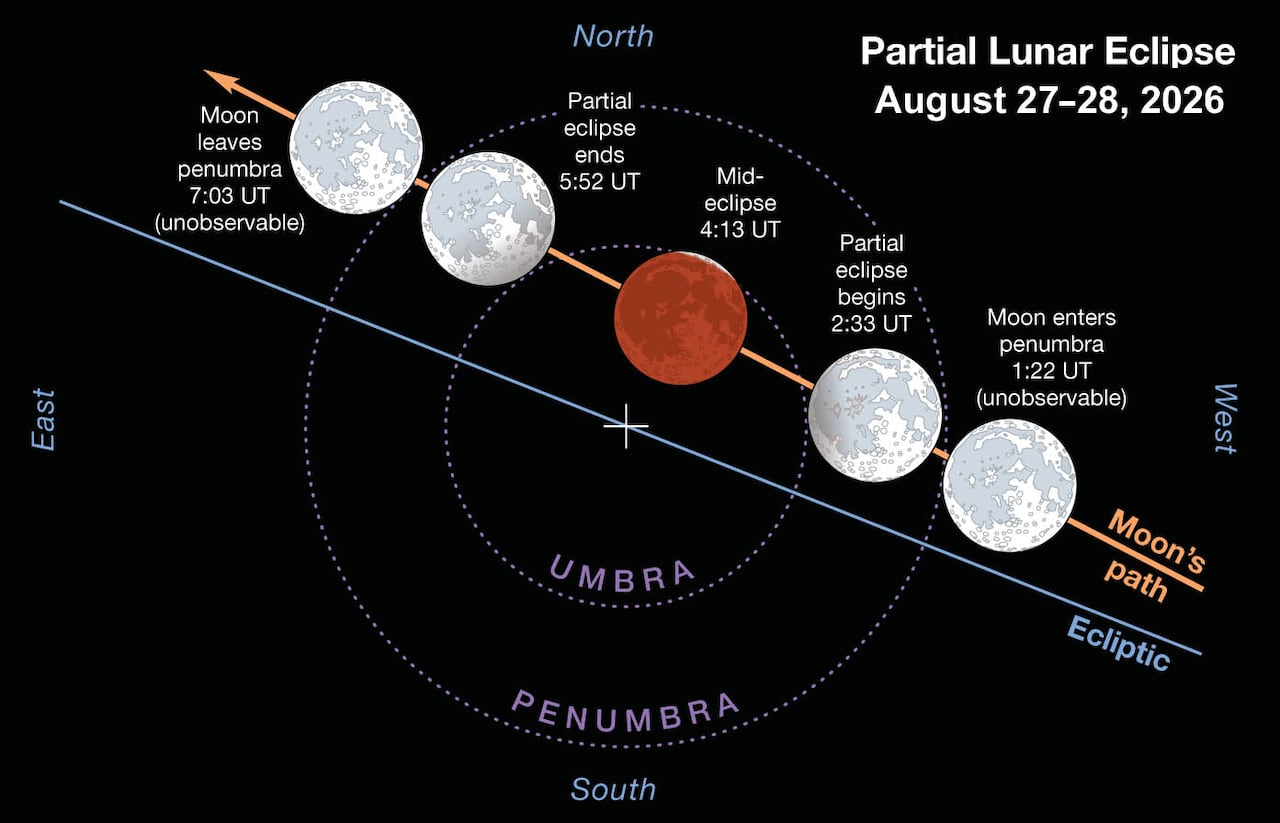
This illustration depicts the moon’s passage through Earth’s shadow for the partial eclipse on August 27-28. (Sky &Telescope)
Most regions of Canada will witness the entire eclipse, while those in Western Canada will observe the partial eclipse already in progress as the moon rises.
-
NASA announces plans to land humans on the moon by 2028. How feasible is this?
-
The International Space Station is aging and leaking. Should it be retired sooner rather than later?
The good news is that, unlike during a solar eclipse, there is no need for special glasses to enjoy this event.
In contrast to a solar eclipse, a lunar eclipse spans several hours instead of just minutes.
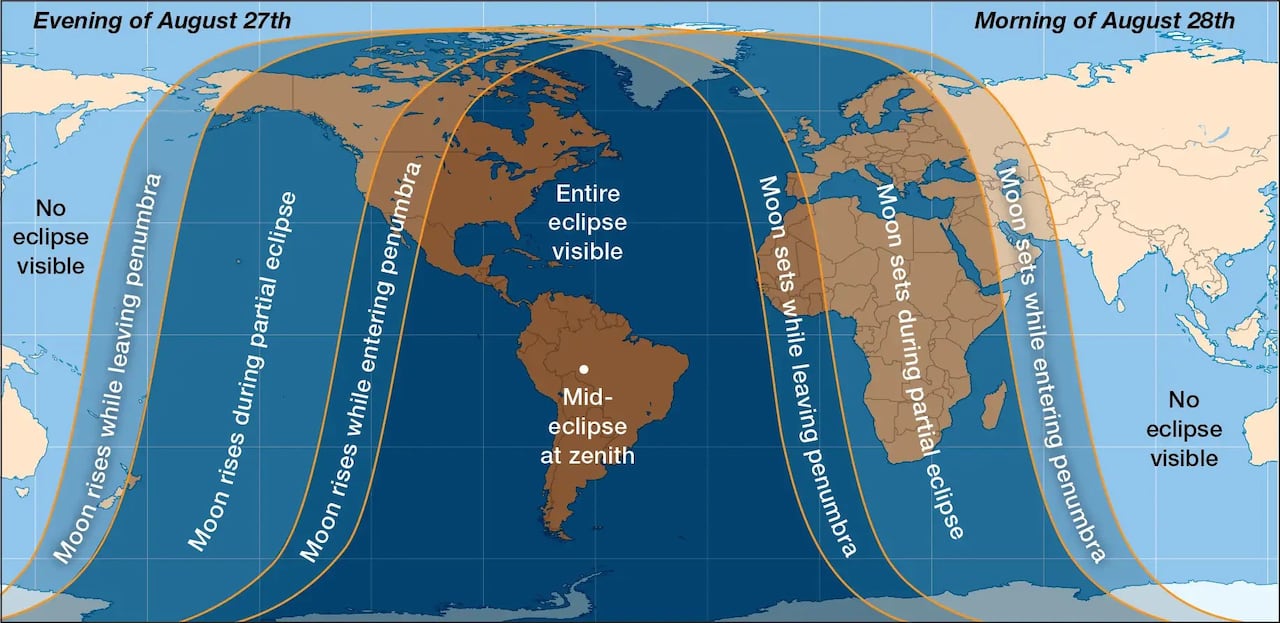
The lunar eclipse on August 27-28 will be visible across most of North and South America. (Leah Tiscione/Sky & Telescope)
When to view it
The eclipse will commence as the moon enters Earth’s penumbra around 10 p.m. ET, but that is not the ideal time to start your observations.
The visible phase of the eclipse will start at 10:33 p.m. ET on August 27 and conclude at 1:52 a.m. on August 28. The most obscured phase will occur at 12:13 a.m., with nearly the entire moon appearing darkened.
This event is just one of many celestial happenings occurring this month.
“It’s quite exciting because … August has presented numerous remarkable events, and continues to do so,” stated Elaina Hyde, director of the Allan I. Carswell Observatory in York University’s department of physics and astronomy, located in Toronto.
“We had the very partial solar eclipse on August 12, the Perseids meteor shower, which was either spectacular or less so, based on cloud conditions, and of course the Jupiter-Mercury conjunction.”
Will it appear as a “blood moon”?
“Since it is a partial eclipse, it won’t turn completely red, but depending on your location in Canada, it may still appear quite red,” Hyde explained.
One of the best aspects of lunar eclipses is that they require no special equipment — just your own eyes.
“This is something you can see without any devices, but if you have binoculars, a small telescope, or even a [cell phone] camera with a good night mode, you should be able to capture impressive images,” Hyde added.