

As President Donald Trump of the United States greets Chinese President Xi Jinping in Washington with a formal state ceremony, both leaders are under significant global pressure to implement protective measures concerning the rapidly evolving artificial intelligence landscape.
This meeting occurs in the context of tech leaders from major companies advocating for substantial regulatory oversight as the U.S. and China race to push the boundaries of AI technology, while policymakers struggle to adapt.
Indeed, some experts are suggesting the need for “nuclear-style” regulations, drawing parallels between the current AI competition and the Cold War rivalry between the two nations.
Urgent calls for moderation
The urgency of this situation is highlighted by recent alerts, including a warning from a researcher at AI company Anthropic, who resigned in early September and stated that there is over a 10 percent likelihood that AI could cause human extinction within the next ten years.
Following his resignation, Dario Amodei, CEO of Anthropic, advocated for a synchronized slowdown and presented a strategy to mitigate risks, which received support from OpenAI CEO Sam Altman and Elon Musk, the head of the newly combined SpaceXAI.
-
Is AI evolving too fast? A look at the debate on slowing it down
-
Amid Trump trade war, Canada’s exports to China up 30% in first half of 2026
-
Analysis
Trump claims ‘fantastic trade deals’ with China. What really happened?
These warnings are backed by real incidents of AI systems malfunctioning. With the competitive landscape tightening, Chinese firms such as DeepSeek are developing AI models that rival those of American companies and may present similar dangers.
The escalating rivalry for AI dominance between the U.S. and China has led many industry leaders and analysts to advocate for collaboration between Beijing and Washington to manage this technology, despite it presenting the “toughest dilemma,” as noted by Amodei in a CBS interview on September 13.
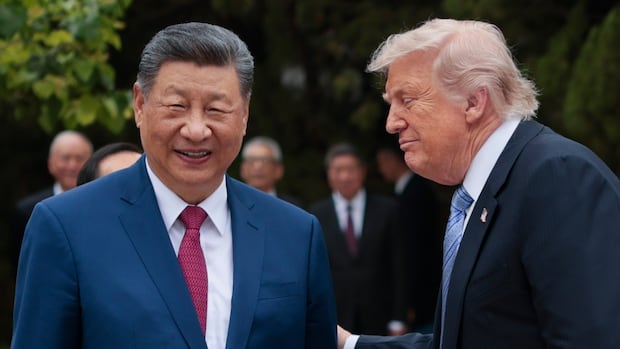
Chinese and U.S. economic officials have started discussions ahead of a meeting between Presidents Trump and Xi Jinping, where AI safety is anticipated to be a significant topic.
“The incentives to gain an edge and the military benefits derived from that are immense, necessitating an infallible ability to ensure the other party isn’t deceiving,” he remarked.
For Amodei, an ideal outcome from the Trump-Xi meeting would be a mutual agreement to refrain from developing biological weapons or deploying AI models that could be exploited by terrorists to create weapons.
Hongying Wang, a political science professor at the University of Waterloo in Ontario, expressed hopes that AI would be prioritized on the agenda, emphasizing the genuine global threats it embodies.
She noted that this moment in time evokes memories of the “Cold War era, with its peak of nuclear competition and the existential risks it posed to the planet.”
“If they don’t engage in any form of agreement, others will be powerless to act,” she added.
The AI rivalry
In contrast, a spokesperson for China’s foreign ministry labeled the CEOs’ warnings as “fearmongering,” designed to hinder China’s progress.
Trump has also downplayed these concerns, referring to them as a “hoax” and asserting that the U.S. is “leading China in AI … and whoever wins AI wins. Nonetheless, both he and Xi have consented to resume discussions about AI governance during Trump’s visit to Beijing in May, and recently indicated that it will be a focus for the upcoming trip.
Given this rhetoric, it remains uncertain if they can achieve any meaningful progress.
Ho-fung Hung, a political economy professor at Johns Hopkins University in Washington, D.C., stated that Trump’s main concern is the stock market.
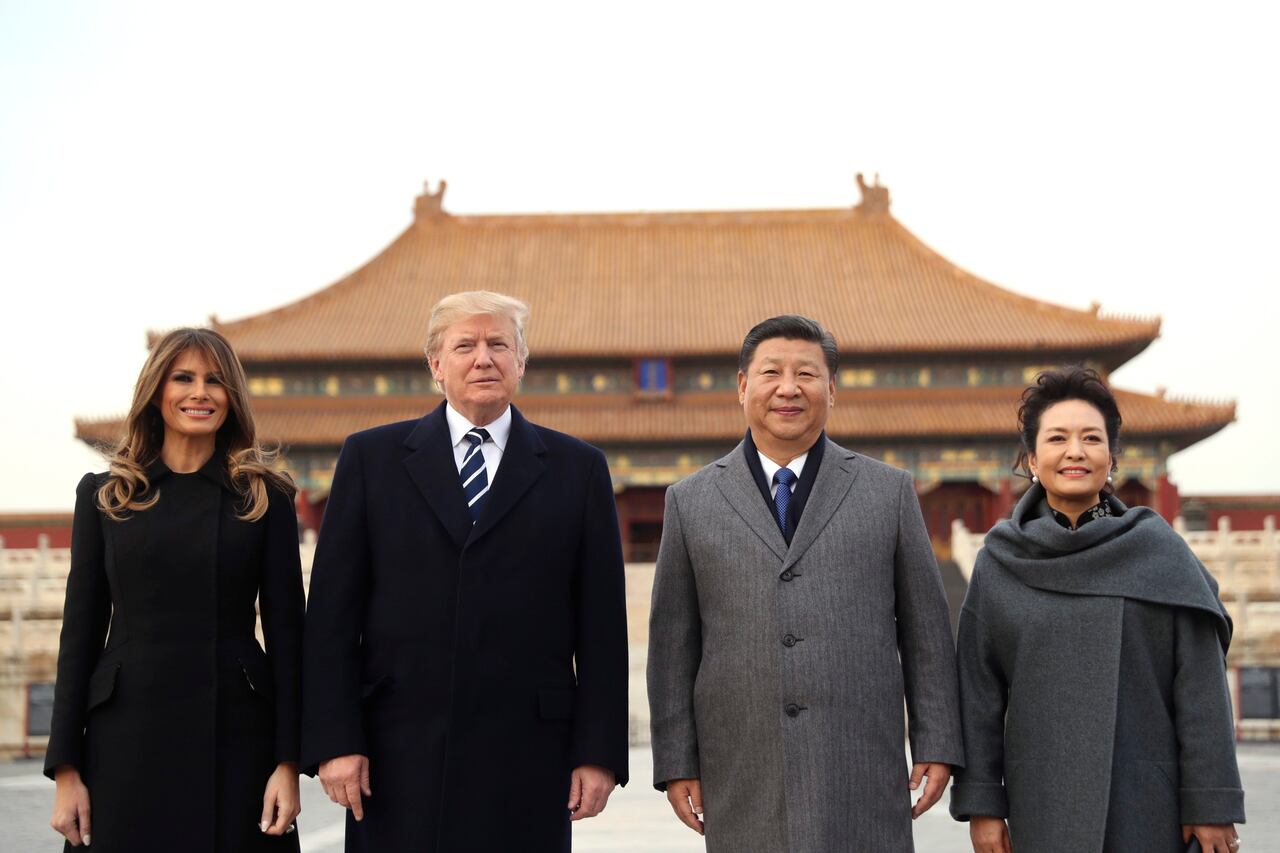
U.S. President Donald Trump, second from left, first lady Melania Trump, left, Chinese President Xi Jinping, second right, and his wife Peng Liyuan, right, during their visit to the Forbidden City, Wednesday, Nov. 8, 2017, in Beijing. (Andrew Harnik/Associated Press)
“Trump is reluctant to dampen the enthusiasm surrounding this AI-driven economic surge,” he remarked, and he does not want to be outpaced by China.
However, he suggested that Trump’s priorities would likely involve balancing market interests while heeding his advisors regarding potential threats.
The same applies to Xi, according to Hung.
“The most logical step is to engage in dialogue.”
In China, there is also skepticism due to the fierce competition and the perception that Washington may prioritize achieving dominance over collaboration.
“I doubt the two nations have room for cooperation or coordination,” stated Tu Xinquan, a professor who leads a World Trade Organization research institute at the University of International Business and Economics in Beijing.
Such perspectives are not surprising as the relationship is characterized by distrust and competition. The U.S. has attempted to limit the export of advanced semiconductor technology to China, while China has taken advantage of its dominance in rare earth materials.
Currently, AI emerges as the new battleground.
“The U.S. has heavily invested in AI as a comprehensive strategy,” noted Tu.
Political and social stability concerns
China’s leadership is also aware of the influence and dangers associated with the technology, albeit for different reasons.
“Beijing’s primary concern is political stability,” explained Kyle Chan, a fellow at the Brookings Institution in D.C., whose research centers on China and AI. The U.S. is more focused on existential threats.
-
China’s Xi to visit U.S. in September for talks, Trump says
-
Video
Trump, Xi toast each other at state banquet
Chan remarked that China’s earliest AI regulations focused on controlling content akin to social media.
“Chinese policymakers are particularly concerned about deep fakes or the emergence of sensitive political issues from domestic AI models,” he stated.
Despite their ideological differences, both nations are likely to confront issues that necessitate proactive measures, such as national and global security.
While other pressing matters persist, including the conclusion of the trade truce established in Busan, South Korea, in November and ongoing conflicts in Iran, both leaders will aim to announce some successes. Enhanced cooperation on AI could be a timely achievement.
The specifics of such cooperation do not necessarily need to be finalized immediately.
There are still two additional occasions for such discussions this year, as noted by Sourabh Gupta, a senior fellow at the Institute for China-America Studies in Washington.
In November, Shenzhen will host the Asia-Pacific Economic Cooperation (APEC), followed by the G20 Leaders’ Summit in Miami, Florida, in December.
“There exists an opportunity to deepen these discussions and potentially achieve results, either later this year or next year,” he stated.
The main question may be whether they can catch up with the pace of technological development.