

Officials from the U.S. have requested that Israeli Prime Minister Benjamin Netanyahu denounce a blockade established by Jewish settlers in a Palestinian community, according to statements made by U.S. and Israeli officials on Friday. This demand follows the settlers’ actions in Qusra, where they set up a new tent to exert pressure on residents just before Israeli soldiers intervened and dismantled it.
For nearly a week, settlers have been surrounding homes in Qusra, located in the occupied West Bank, effectively trapping Palestinians in an area where rights organizations report a systematic effort by settlers to expand their territory, further encroaching upon the land where Palestinians aspire to build a state.
The blockade has received public censure from U.S. officials: U.S. Ambassador to Israel Mike Huckabee, a noted advocate for Jewish settlement in the West Bank, labeled the settlers besieging a Palestinian residence as “Israeli terrorists” on Thursday.
A U.S. official and an Israeli counterpart indicated on Friday that White House representatives are urging Netanyahu to make a public statement against the blockade.
The U.S. government began voicing objections after discovering that the residence of a Palestinian-American was among those affected, according to the two officials, who spoke on the condition of anonymity due to the sensitive nature of the discussions.
“A stable West Bank contributes to Israel’s security and aligns with this administration’s objective to foster peace in the region,” a White House official stated in a remark to Reuters on Friday.
As of now, Netanyahu has not issued any remarks concerning the blockade in Qusra. Neither his office nor the White House has provided immediate responses to inquiries for comments.
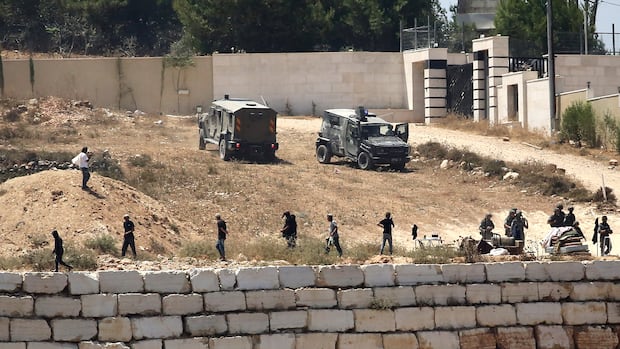
The aggressive actions of Israeli settlers surrounding Palestinian homes in the occupied West Bank have elicited a rare condemnation from U.S. Ambassador to Israel Mike Huckabee.
Incidents of violence by settlers in the West Bank have surged in the three years following the Hamas-led attacks on Israel on October 7, 2023.
For Netanyahu, condemning the settlers could be a politically sensitive move just two months before elections, as it might alienate settler voters who are essential to parts of his right-wing coalition. Polls indicate that Netanyahu’s political standing could be precarious, particularly as his security reputation has been undermined by the 2023 Hamas attacks.
“We are very afraid,” stated Aysha Hassan, a Palestinian woman residing in one of the besieged homes in the village, during a phone interview with Reuters.
“This is nothing new. It’s been like this for six days… the settlers are still here.”
Hassan reported that she witnessed settlers congregated below her house in the early morning hours and shared videos with Reuters that showed groups of settlers moving around beneath her window.
-
Mike Huckabee, U.S. ambassador to Israel, condemns ‘horrific’ violence in West Bank
-
Prosecutors charge Israeli settler for killing Palestinian activist in West Bank
She mentioned that the trapped residents received some assistance, including food, bottled water, and canned goods delivered by foreign and Israeli activists on Friday. However, the military restricted direct delivery to the homes, citing the area as a closed military zone.
According to her, the military permitted them to leave the houses to collect the aid laid out on a dirt path, which they could then bring inside.
The United Nations has reported that approximately 15 Palestinians, including two children, are trapped in their homes without access to water or electricity.
Footage recorded by a Palestinian resident confined in another besieged home and obtained by Reuters captured seven settlers outside, positioned near a blue tent. One settler appears to be throwing stones towards the nearby village, while another is seen arriving with chairs.
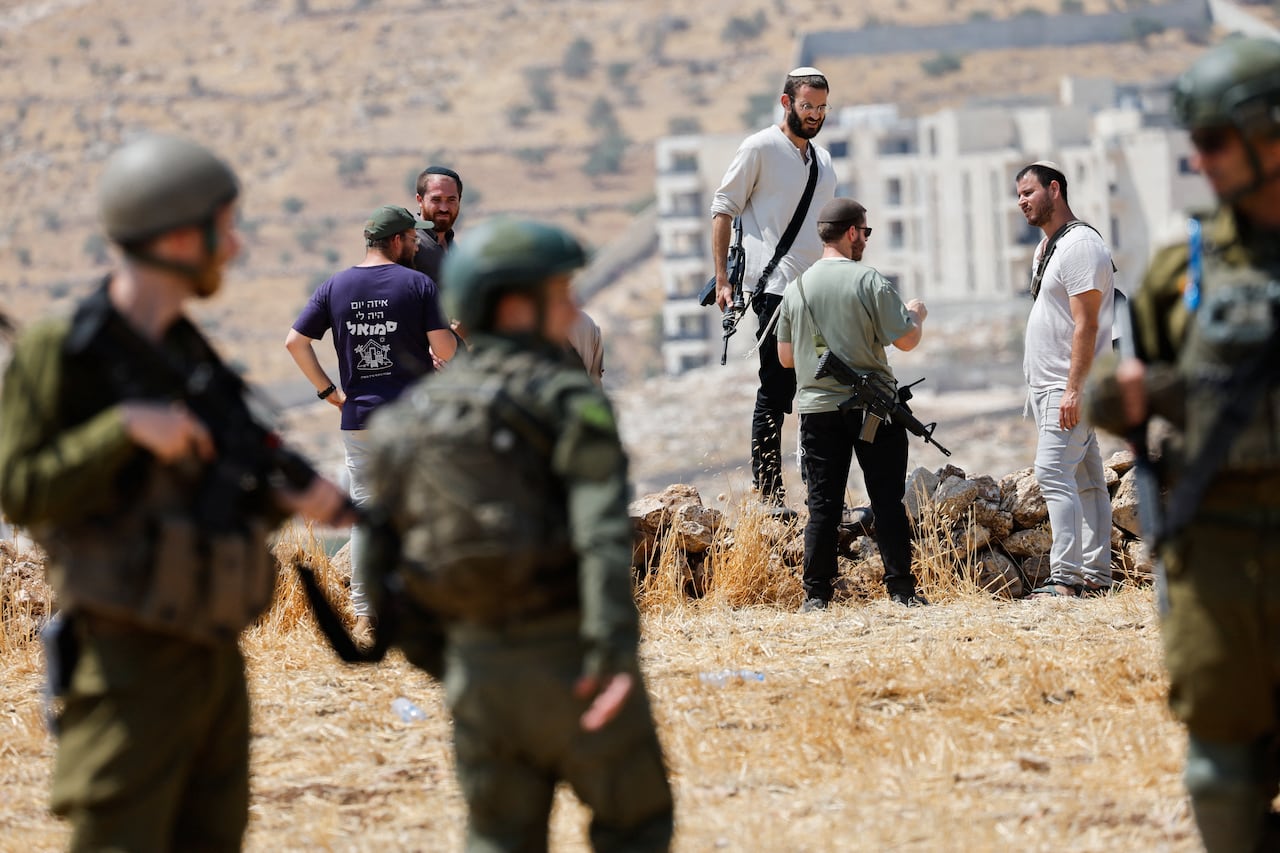
Armed Israeli settlers gathered near Israeli soldiers, as Palestinian and Israeli activists accompany Palestinian landowners in their property, which is threatened with confiscation by Israeli settlers, in Beit Sahour on Friday. (Mussa Qawasma/Reuters)
Following this, Israeli army vehicles and personnel arrived, and the tent was observed collapsed on the ground.
The Israeli Defence Forces (IDF) issued a statement, explaining that “Israeli civilians erected a tent in the Qusra area, and IDF soldiers intervened to remove it while ensuring the local residents’ safety,” a day after a significant number of troops were deployed into Qusra and occupied several homes in the village.
Netanyahu’s administration, recognized as the most right-wing in Israeli history, has actively promoted a swift expansion of settlements in the West Bank, an area captured by Israel during the 1967 war. Dozens of new settlements and settler outposts have been established in this region.
Human rights organizations assert that settlers are attempting to take control of properties on the outskirts of Qusra and neighboring Jalud as part of a broader strategy to link the land between them and integrate it with settler outposts to the south and larger settlements to the west.
The blockade commenced over the weekend when settlers barricaded the road leading to three homes and erected a tent in their front yards, prohibiting anyone from entering or exiting. They had previously cut off the electricity and water supply to the homes.
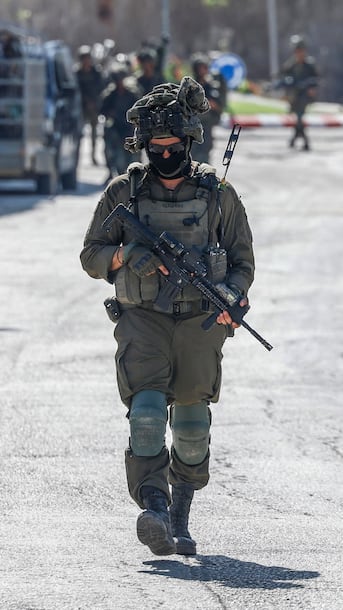
Local officials and family members report that Israeli settlers have confined at least two Palestinian families within their homes in Qusra in the occupied West Bank, cutting off their water and electricity supplies. Israel claims it has dispatched military personnel to the village to restore order.
The IDF has confirmed the deployment of soldiers in Qusra since Thursday morning to safeguard residents and ensure security.
Earlier in the week, video footage showed several Israeli individuals in military attire participating in morning prayers with settlers in the tent. The military stated it is taking disciplinary measures against any personnel found to be involved.
The West Bank is home to approximately three million Palestinians and around 500,000 settlers. There are about 146 settlements along with 390 smaller outposts, as reported by the Israeli settlement monitoring organization Peace Now.