


It may come as a surprise to know that the exotic-flavored pawpaw fruit grows locally in Canada. Chef Tawnya Brant believes that if you manage to obtain one, you are in for a delightful experience.
Brant, the owner of Yawékon Foods and host of APTN’s One Dish One Spoon, describes the pawpaw as a blend of banana, mango, and pineapple flavors with a creamy consistency that becomes almost caramel-like when ripe.
She compares the fruit to an unusual banana, slightly shorter and plumper, resembling an oval shape with large seeds inside.
Pawpaws have been a part of North American flora for centuries, once thriving from Florida to Missouri and southern Ontario. They were traditionally cultivated by Indigenous communities before being displaced due to land clearance for agriculture. While still found in the wild and some orchards in select regions like southern Ontario, British Columbia, and Quebec, pawpaws typically bear fruit in the autumn.
One reason pawpaws remain relatively unknown is their short shelf life, quickly browning after harvesting. Additionally, they are susceptible to bruising, making large-scale commercial harvesting and distribution challenging.
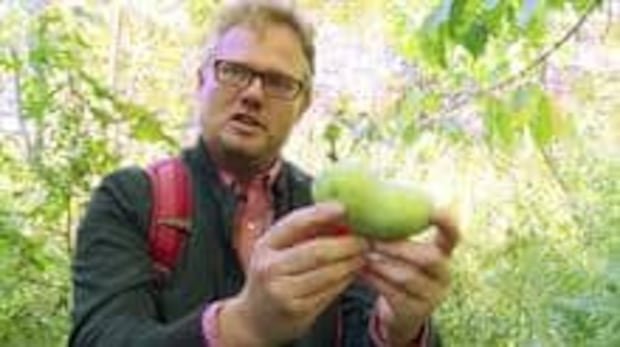
Exploring wild pawpaws in a secluded location near London, Ont., with forager and ecologist Mathis Natvik.
Brant’s introduction to pawpaws occurred approximately ten years ago when a friend brought some to her mother’s garden. She had heard of the fruit before and learned that the Haudenosaunee people transported the trees up the eastern coast over generations due to their fondness for them.
She recalls stories of children using rafts to collect pawpaws from creeks, emphasizing that enjoying the fruit was a rare yearly event since preservation methods were limited.
The secret to cultivating pawpaws? Llama dung
About 15 years ago, Thomas Mathias initiated pawpaw cultivation on his farm. Initially an experiment, it took years of trial and error before successfully producing fruit.
Mathias mentioned that