

The breakdown of negotiations with the United States has intensified the need to eliminate trade restrictions within Canada. However, experts caution that the solution is not straightforward.
Recently, initiatives to enhance interprovincial trade have gained momentum. For instance, last month, nine provinces reached an agreement to permit direct-to-consumer alcohol sales between provinces.
Nonetheless, even this incremental advancement—focused on a niche segment of the alcoholic beverage market—illustrates the hurdles associated with expanding sales. Some provinces have imposed additional fees and regulations beyond those that producers encounter in their own regions.
“Paying two wholesale markups is just absurd,” remarked Jeff Guignard, CEO of Wine Growers British Columbia.
He argued that requiring B.C. wineries to register in other provinces simply to ship wine contradicts the ongoing efforts to liberalize trade within the country.

Lauren Skinner Buksevics, managing director of Painted Rock Estate Winery in Whistler, B.C., mentions that U.S. tariffs have led her American partner to stop importing her wines. However, she points out that this market is limited compared to the Canadian market, which still faces interprovincial trading obstacles.
“It’s just a lot of bureaucratic nonsense that is unnecessary,” Guignard stated.
“For far too long, we have treated each province as if it were a completely distinct economy, which it is not. We are talking about a single Canadian economy.”
The potential advantages of streamlining domestic trade are considerable.
The International Monetary Fund projects that eliminating internal trade barriers could elevate Canada’s real gross domestic product by over seven percent, which translates to approximately $210 billion in the long term.
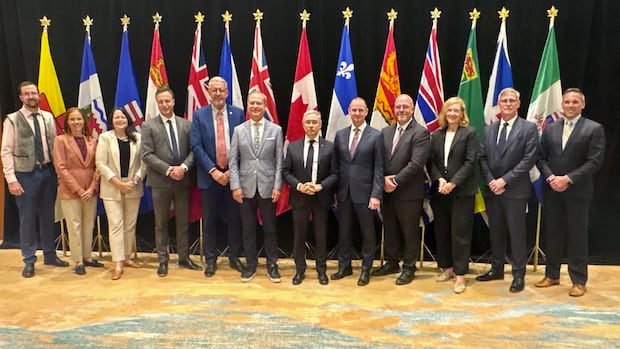
Finance ministers convened in P.E.I. to discuss trade and additional matters. CBC’s Cody MacKay reported on the discussions.
CIBC offered a more cautious estimate in March, suggesting a potential one percent increase in GDP. However, the bank acknowledged that such progress would still be beneficial and worth pursuing.
This week, federal and provincial ministers gathered in Iqaluit to advance the concept of a “one Canadian economy” and to focus on dismantling barriers.
Before the meeting, Internal Trade Minister Dominic LeBlanc stated that while advancements have been made, there remains much work to be done as the United States shifts its trade policies.
Key topics for the meeting included striving for an agreement on a smoother flow of services nationwide by year-end, standardizing the approval process for prefabricated homes and new building materials, and facilitating food trade within Canada.
The renewed focus on eliminating provincial barriers is welcomed, according to Corinne Pohlmann, executive vice-president of advocacy at the Canadian Federation of Independent Businesses.
“It had seemed for the past six months as though progress had stalled,” she noted.
Pohlmann highlighted significant advancements, such as the provinces’ agreement to acknowledge each other’s standards for goods.
This agreement became effective in June, but ensuring its successful implementation remains a challenge, she remarked.
“Unfortunately, this leads to more intricate details, requiring scrutiny on how each province operates in practice.”

This summer, the province permitted producers to establish more retail outlets and committed to interprovincial liquor trade across Canada. However, as CBC’s Tom Murphy reports, some in the industry are advocating for further changes.
The complexity of regulations means that while someone can purchase a ladder or chainsaw from another province, they might not be able to use it on a job site, she explained.
“If we genuinely aim to function as a single economy across the nation, we must closely examine these issues.”
Wolfgang Alschner, a professor at the University of Ottawa, is undertaking this detailed examination.
As the Hyman Soloway chair in business and trade law, Alschner is leveraging artificial intelligence to catalogue regulations across Canada, aiming to identify unnecessary discrepancies.

B.C. is among nine provinces that have reached a deal to allow Canadian brewers, wineries, and distillers to sell directly to Canadian consumers outside of their home provinces. As Katie DeRosa reports, some in B.C.’s alcohol sector are skeptical and say the devil is in the details.
Many of these rules have been entrenched for a long time, and even if outdated, there has been no impetus to address them, he noted.
He cited public toilet seats as an example, with Ontario being the only province mandating a U-shaped seat. This regulation aligns with U.S. industry standards, restricting trade opportunities with alternate suppliers.
“Although it’s a somewhat absurd example, it illustrates how vested interests and established trade relationships can hinder our ability to engage in international trade effectively.”
To uncover additional hidden trade obstacles, Alschner is working to compile around 17,000 regulatory texts from Canada, each containing numerous sections, aiming to replace an anecdotal approach with a more structured method.
“We are confronted with an immensely complex web of regulatory documentation,” Alschner stated.
While provinces have made strides in acknowledging each other’s regulations, he believes it would be more beneficial to establish a unified set of rules.
“This is critical because we are not just focused on reducing bureaucratic hurdles on paper, but on facilitating more practical trade in reality.”