

Several businesses in Ontario are preparing for tariffs while committing to resilience after trade negotiators from Canada and the U.S. came close to a deal but ultimately did not finalize an agreement late Friday night.
Following weeks of threats and a three-day extension of the deadline, the White House enacted a 50% tariff on approximately $28 billion worth of Canadian exports, including steel, aluminum, and automotive goods.
Kimberly Turner-Briscoe expressed her distress, recounting sleepless nights, including Friday, spent contemplating how to sustain her business amid the ongoing trade conflict initiated by Trump.
As the president of a steel fastener supply and distribution company based in Scarborough, she has had to make difficult decisions over the years, such as shifting her focus away from the U.S. market and reducing her workforce.
Despite her disappointment regarding the tariffs, particularly Canada’s 25% tariffs on fasteners, Turner-Briscoe stated that she is proud the negotiators chose to walk away from an unfavorable agreement.
“Don’t give in. No agreement is preferable to a poor agreement,” she advised the government. “Business is not for the timid. It used to be much more enjoyable than it is now.”
The goods affected by the new tariffs make up about nine percent of Ontario’s total exports to the U.S. projected for 2025, as per Statistics Canada.
During a press briefing on Saturday morning, Prime Minister Carney stated that the U.S. proposed terms that were “uneconomic, unjust, and detract from the net advantages to Canada.”
Canada is taking the reluctant step of implementing retaliatory tariffs “dollar for dollar” across various sectors, including dairy, steel, paper, and electronics, after Labour Day, he added.
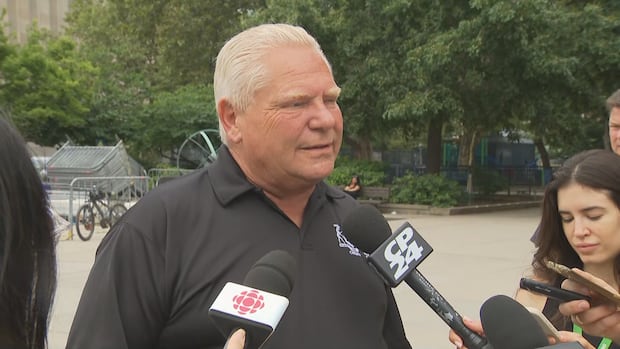
Ontario Premier Doug Ford criticized the suggested trade agreement with the United States as a ‘bad deal’ for the province’s automotive and steel industries. He expressed his support for Prime Minister Mark Carney’s choice to halt negotiations, stating that the province will assist workers and businesses affected by the 50% tariff from the U.S.
Lana Payne, the national president of Unifor, backed the government’s stance, despite acknowledging that some Canadian workers have already been “punished” by tariffs in the last 18 months.
Unifor, representing around 320,000 workers, is Canada’s largest private sector union.
“We have repeatedly witnessed the Trump administration demand concession after concession,” Payne informed reporters Saturday afternoon. “The concessions became so substantial that our Canadian negotiators had no option but to walk away.”
She added, “I believe that was the correct choice. However, it doesn’t imply we are in a straightforward period right now. Our nation and working individuals will face challenging times.”
Payne emphasized the need for Canadians to unite.
“I have always believed we would arrive at this juncture,” she remarked. “We are now in a position where we must draw a firm line. We will need to resist as strongly and strategically as possible.”
Canada didn’t start trade war, but will win: Ford
At a press conference on Saturday, Ford encouraged Ontarians to “remain strong” and expressed his satisfaction that the prime minister did not finalize the agreement with the U.S. He hopes the premiers of Canada will unite as a cohesive front.
“It was a bad deal. It was detrimental to Ontario, the automotive sector, and manufacturing,” he stated.
“We did not initiate this conflict, but I assure you we will prevail.”
Although the upcoming weeks may prove challenging, Ford asserted that Ontario’s diverse economy can endure the obstacles, promising support for workers in affected industries.
Giles Gherson, president of the Toronto Region Board of Trade, remarked that the tariffs will severely impact jobs and investments in the area. He called for coordinated efforts from both the provincial and federal governments against the tariffs.
“Canadians demonstrated what unity means—purchasing Canadian goods, traveling within Canada, and backing local industries,” he stated. “We must transform our economic protest into a formidable economic alliance.”
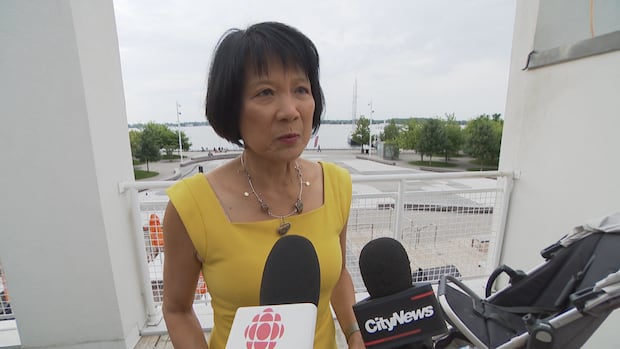
Toronto Mayor Olivia Chow is encouraging residents to support local businesses as Canadian companies now face 50% tariffs from the United States. She backed Prime Minister Mark Carney’s choice to suspend trade negotiations with the U.S. and affirmed that Canadians will “fight back.”
Turner-Briscoe noted a significant change in her customer base as Canadians increasingly choose to purchase local products.
“We must reduce our dependence on the U.S. If nothing else, this is a valuable lesson,” she remarked.
Toronto Mayor Olivia Chow echoed this sentiment during an event on Saturday, stating that the city would leverage its purchasing power to support local businesses. She highlighted that while the U.S. is experiencing job losses, Toronto is poised to generate thousands of new jobs.
“If others attempt to intimidate us and weaken our resolve, we will not yield,” she asserted. “This is our moment to unite … and thoroughly consider how we can foster local employment.”
Brampton Mayor Patrick Brown took to social media platform X to declare that “no deal is better than a bad deal.”
“We have developed this nation’s automotive sector and the associated supply chains over the last 80 years, and we will not relinquish that nor retreat,” he stated. “Now is the time for every tier of government, industry, and every Canadian to join forces in support of Canadian workers, businesses, and our economy.”
According to Brown, nearly 3,000 workers are currently unemployed due to the closure of the Stellantis Assembly Plant in 2023. Earlier this month, a national union reported that Stellantis indicated it was seriously contemplating the closure and sale of the Brampton Assembly Plant.
“Brampton is acutely aware of what is at stake if we make the wrong choices,” Brown stated.
Trade war will be costly: experts
Experts, including Ian Lee, associate professor at Carleton University’s Sprott School of Business, warned that the Canada-U.S. trade war will be “extremely expensive” for Canadians.
He indicated that rising prices, increased unemployment, and higher bankruptcy rates could be anticipated, based on research focused on Ontario.
“This will not be a free meal for Canadians,” he conveyed to CBC News on Saturday.
Sectors affected might face workforce reductions or, in the worst-case scenarios, business failures, according to David Soberman, a professor at the University of Toronto’s Rotman School of Management.
Soberman expressed hope for a deal that could provide relief to Canadians.
“We are negotiating with a massive entity next door while we are comparatively small. If that entity decides to roll over, we, as the smaller party, will be crushed,” he explained.
Soberman raised concerns about whether pushing back against the United States was the optimal strategy.
“The government has announced plans for retaliatory tariffs, which aligns with this combative approach, but it ultimately harms us,” Soberman stated.
He hopes Canada will engage in negotiations again to secure the best possible agreement. While both Canada and Ontario are striving to broaden their export base, achieving those agreements will take time to address the current challenges, he noted.