

Recently, President Donald Trump of the United States stated on his social media platform that for more than a century, presidents have acknowledged the strategic significance of Greenland, “but NONE of them were able to take action.”
He further claimed that he had “permanently and conclusively resolved this crucial issue.” On Tuesday, a new security agreement involving the U.S., Denmark, and Greenland was formally signed during the UN General Assembly in New York.
However, the U.S. had already established a security arrangement with Denmark and Greenland that has been in place for 75 years. So, what has changed, if anything?
“When comparing the new defense agreement to the old one, I would say it represents a moderate improvement for the U.S.,” Mikkel Runge Olesen, a senior researcher at the Danish Institute of International Studies, shared with CBC News.
“Yet, this moderate enhancement has come at a substantial cost.”
-
NATO will share Arctic responsibility as Greenland security deal with U.S. moves forward, Denmark says
-
Analysis
Trump flexes ‘American power’ on UN’s biggest stage
Some analysts argue that the cost is reflected in the strain on relationships between the U.S. and several NATO allies, including Denmark and Greenland, stemming from Trump’s repeated threats to take control of the northern island and incorporate it into the U.S.
“While I don’t believe this agreement introduces significant new elements, I think it is a relief that it is finally being signed,” remarked Imran Bayoumi, a deputy director with the GeoStrategy Initiative in the Atlantic Council’s Scowcroft Center for Strategy and Security.
He added that the “benefits are minimal” when weighing the damage done to the direct relationships between the U.S. and its NATO partners.
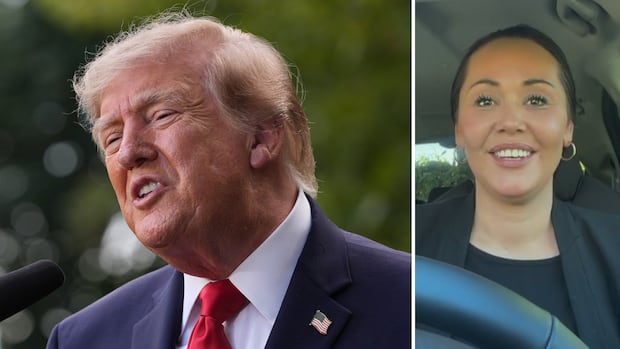
Tillie Martinussen, a former member of Greenland’s Parliament, indicates that while the specifics aren’t disclosed, the agreement to be signed Tuesday by Denmark, Greenland, and the U.S. seems to reaffirm a pact established since 1951 — just ‘don’t inform Donald Trump.’
Comparing the agreements
In 1951, the U.S. and Denmark entered into the Defense of Greenland Treaty, which allowed for a U.S. military presence in designated areas of the island.
During the Cold War, the U.S. operated 17 military bases and employed over 10,000 personnel in Greenland. Currently, only the Pituffik Space Base remains, with approximately 150 U.S. military members stationed there.
As part of the new agreement, it was also disclosed that the U.S. intends to establish two additional military bases.
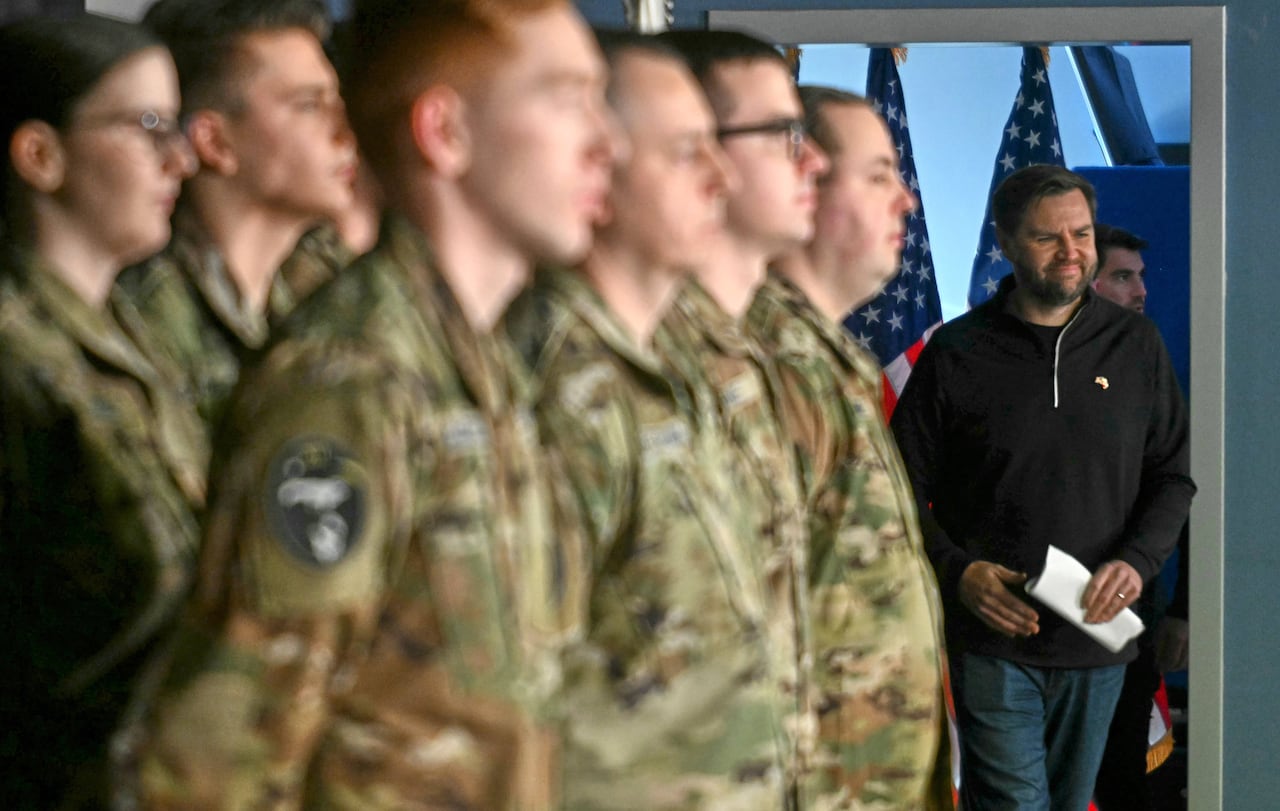
U.S. Vice-President JD Vance arrives to speak at the U.S. military’s Pituffik Space Base in Greenland, in March 2025. (Jim Watson/The Associated Press)
However, under the previous agreement, the U.S. already possessed the authority to enhance its bases. Instead, its military presence had diminished in terms of both personnel and facilities over the years, as noted by Marc Weller, the director of the Global Governance and Security Centre and the International Law Programme at Chatham House, a London-based think tank.
“Now they possess the right, in consultation with Denmark and Greenland, to agree on additional bases,” Weller explained.
He further mentioned that both parties had previously shown they were agreeable to an expansion of U.S. bases.
“This was not a contentious issue.”
-
Trump says deal struck to boost U.S. military presence in Greenland
-
Greenland, Denmark say deal with U.S. will not cede sovereignty
The new agreement also forbids foreign adversaries, such as Russia and China, from setting up bases on Greenland.
However, even under the 1951 agreement, such a scenario would have been “unthinkable,” according to Olesen.
“How many Russian and Chinese bases do we actually observe in NATO member countries these days? It was always understood that this would never transpire. But now it’s documented in writing.”
With the new agreement, the U.S. successfully negotiated the capability, in collaboration with Denmark and Greenland, to prevent adversaries from investing in critical sectors.
Such investments would require the consensus of all three nations to ensure they do not pose a national security threat.
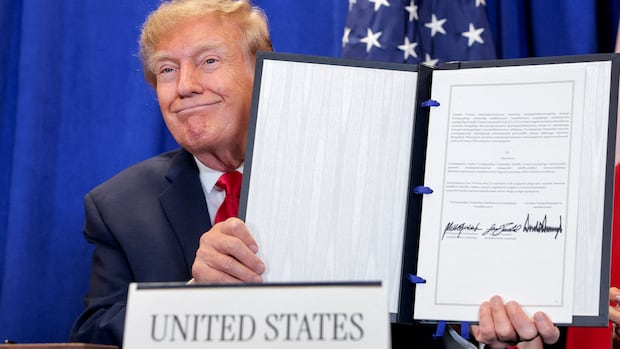
U.S. President Donald Trump signed a deal with Denmark and Greenland to enhance the American military presence on the island while still recognizing Denmark’s sovereignty over its self-governing territory.
Bayoumi emphasizes that there are logistical challenges already hindering this. He points out that constructing infrastructure in Greenland is extremely difficult, and the necessary support for a critical mineral extraction initiative is lacking.
Not only would developing that infrastructure be expensive and time-consuming, but Greenlanders have previously rejected various mineral extraction proposals due to environmental concerns.
If the U.S. intends to block other nations from investing in Greenland, Bayoumi questioned whether it is prepared to take on a broader role “in promoting economic development on the island.”
‘Infinite Life’ agreement
The new agreement also lacks a termination date, which Trump referred to as an “Infinite Life” pact.
Bayoumi notes that this is a novel aspect, as the 1951 treaty was linked to the existence of NATO. The updated agreement also allows Greenland to exercise its right to pursue independence.
Nonetheless, Bayoumi points out that NATO is unlikely to dissolve anytime soon, and the prospect of Greenland’s independence is also not imminent.
-
Iceland summons U.S. ambassador over Trump’s threat to take over Arctic nation
-
Inuit delegation in Greenland for opening of Canadian consulate has a message for Trump: ‘Back off’
Under the terms of the new agreement, should Greenland opt for independence, it would commit to remaining in NATO and adopting Denmark’s rights and responsibilities under the agreement.
“This was likely implied in previous iterations, but it is beneficial for the U.S. to clarify this,” Weller stated.