

On Friday, U.S. President Donald Trump encouraged Americans to accept a slight increase in gasoline prices as a necessary measure to prevent Iran from acquiring nuclear weapons. He also announced plans to declare the Strait of Hormuz as U.S. territory in the near future.
This statement highlights the increasing political challenges Trump faces as rising fuel costs clash with his campaign promise to reduce energy prices. Democrats are already positioning the economic repercussions of the conflict with Iran as a critical issue leading up to the midterm elections in November.
<pDuring a speech in Garden City, New York, Trump remarked that Americans who had to "pay a tiny little bit more for your gasoline" should keep in mind that this expense was crucial to ensure that "a very evil country" could not develop nuclear capabilities.
‘We’re really doing a great job’
Trump stated, “What we’re doing is a great service for the world, not just for ourselves … and we’re really doing a great job,” asserting that he would never apologize for his actions against Iran.
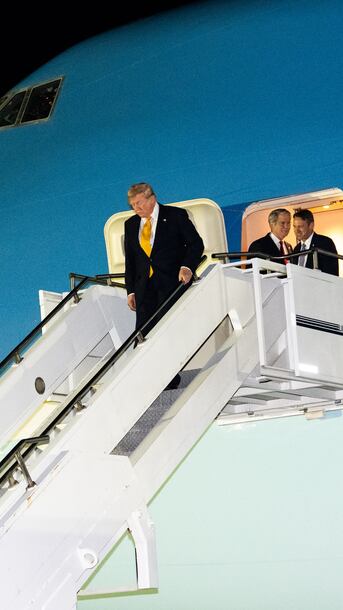
U.S. President Donald Trump was secretly moved onto another jet due to an apparent threat from Iran after last month’s NATO summit in Turkey, For The National, the CBC’s Eli Glasner breaks down how they pulled it off and the potential wider security implications.
Approximately 20 percent of the world’s oil and LNG shipments typically transit through the Strait of Hormuz, and concerns over potential long-term disruptions have driven oil prices upward.
Trump stated, “After we finish defeating Iran … pretty soon I’ll be declaring the Hormuz Strait a territory of the United States,” intensifying his language regarding this crucial waterway.
It remains uncertain how seriously Trump intended this statement or if it reflects a shift in policy.
Iranian official reacts
Kazem Gharibabadi, the deputy foreign minister of Iran, referenced Trump’s comments in a post on X, asserting that the strait could not “be seized by tweet, nor by aircraft carrier, nor by issuing an order, nor by an election speech.”
He further remarked that the strait would “only be closed and opened under Iran’s command.”
Trump’s statements come amid ongoing tensions in the Strait of Hormuz, which remains a significant point of pressure for global energy markets.
This week, oil prices have surged, with Brent crude nearing $90 per barrel, while U.S. gasoline prices have risen to about $4 per gallon.